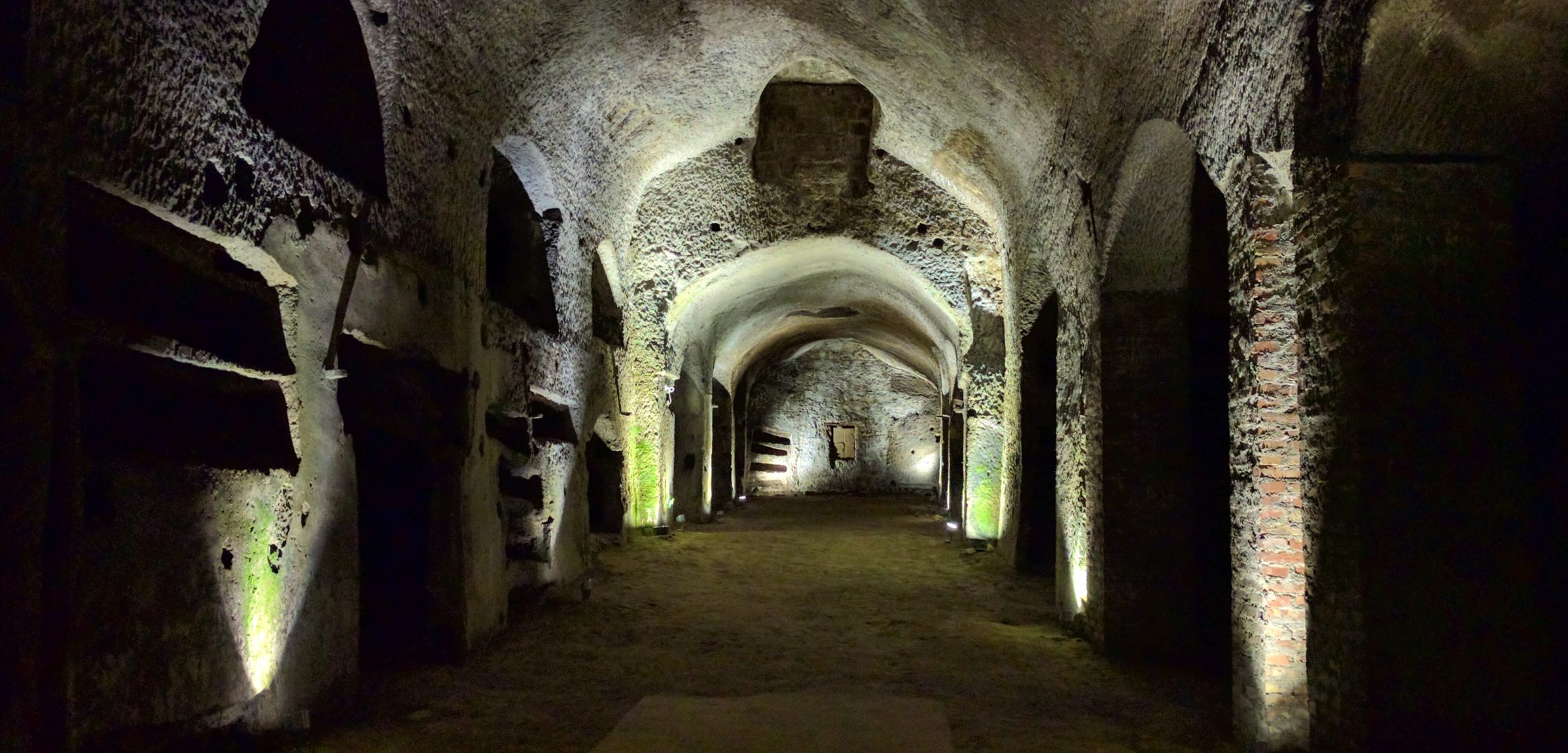

As you’re reading this, I’m in Italy leading a Southern Seminary study tour through Rome. In the past two days, I’ve spent time praying in Saint John Lateran Cathedral here, and in the ruins of the ancient Christian catacombs. It struck me that we Christians sometimes forget the paradoxical grace of God in giving us a legacy of both cathedrals and catacombs.
The catacombs, of course, are the legacy of a tiny persecuted band of believers, meeting in their graveyards to escape the all-seeing eye of imperial Rome. The cathedrals represent a very different turn in church history: a church that not only could grow in size but could, in fact, outgrow and outlast the Empire itself. The catacombs represent simplicity and earthiness; the cathedrals transcendence and wonder.
We need both, somehow.
Sometimes American evangelicals, traveling to sites of significance in church history, are disappointed. They want to see a Disney-type restoration of “the early church” in a way that makes it seem as though the faith went by time-warp straight from a pristine golden era to the Graham Crusades. This sort of Christian tends to like the catacombs, for the same reason some people love working on their antebellum family histories but don’t like family reunions.
But the catacombs and the cathedrals both remind us of two things: God’s sovereignty in sending down the faith, and the frailty of humanity as stewards of that faith. We can’t romanticize the early persecuted church. After all, the New Testament Scriptures are often rebuking those churches for precisely the things we see going on in our churches today: division, carnality, immorality, arrogance (1 Cor. 4:7-13, 5:1-8, 6:1-8). And, if Christianity had remained in the catacombs, it is quite possible that you and I would have never encountered Christ.
The basilica at Saint John Lateran was planted there by the Emperor Constantine. As a Baptist committed to separation of church and state, I have huge problems with Constantine. His vision of a Christian empire was, of course, a failed experiment that led to persecution and all sorts of nominal Christianity. And yet, God used Constantine to end a bloody persecution and to, among other things, call together the church to deal with a deadly heresy or two. In the providence of God, the Trinitarian theism by which I critique the idea of Christian empire came down to me due, in part, to the unwitting actions of the prototypical Christian emperor.
Crawling through catacombs and walking through cathedrals reminds me of the paradoxical wonder of the way Jesus speaks of the kingdom of God. On the one hand, King Jesus speaks of the kingdom as tiny, a “little flock” hounded by wolves (Luke 12:32; Acts 2:29). The way is narrow, he tells us, and there are few who enter therein (Matt. 7:14). On the other hand, Jesus tells us the kingdom is like a tiny seed that grows into a massive tree in which all the birds of the air may rest (Mark 4:30-32).
If we only see the catacombs, we could valorize smallness and persecution as, in and of themselves, equivalent to holiness. And we could ignore our responsibility to, as much as possible with us, protect future generations from persecution. If we only see the cathedrals (whether of the ancient sort or of the local suburban megachurch), we could tend to identify godliness with bigness, and authority with “influence.”
There’s a lot in church history that went wrong. The people who built these majestic cathedrals were sinners deserving of hell. So were the martyrs of the catacombs. So are we. Lots of bad decisions were made in the history of the church, and some of them persist. But the biblical story, too, was filled with sinful people making stupid decisions, and, in all that, God was working everything out toward the glory of Christ (Rom. 9:4-5).
In the heroic stories of church history (Athanasius defeats Arius! Augustine turns back Pelagius!) and in the awful parts (state churches and triumphalism and scandals), God is orchestrating a flow of the river of redemption that takes it from the hillsides of Judea through the bustling streets of Antioch right down to that Baptist church in Arkansas, or wherever it was that you first heard the name of the Christ of God.
The kingdom of God is vast and tiny, universal and exclusive. Our story is that of a little flock and of an army awesome with banners. It’s a Christianity of persecution and proliferation, of catacombs and cathedrals.