Why Zombies Matter
— Wednesday, October 31st, 2012 —
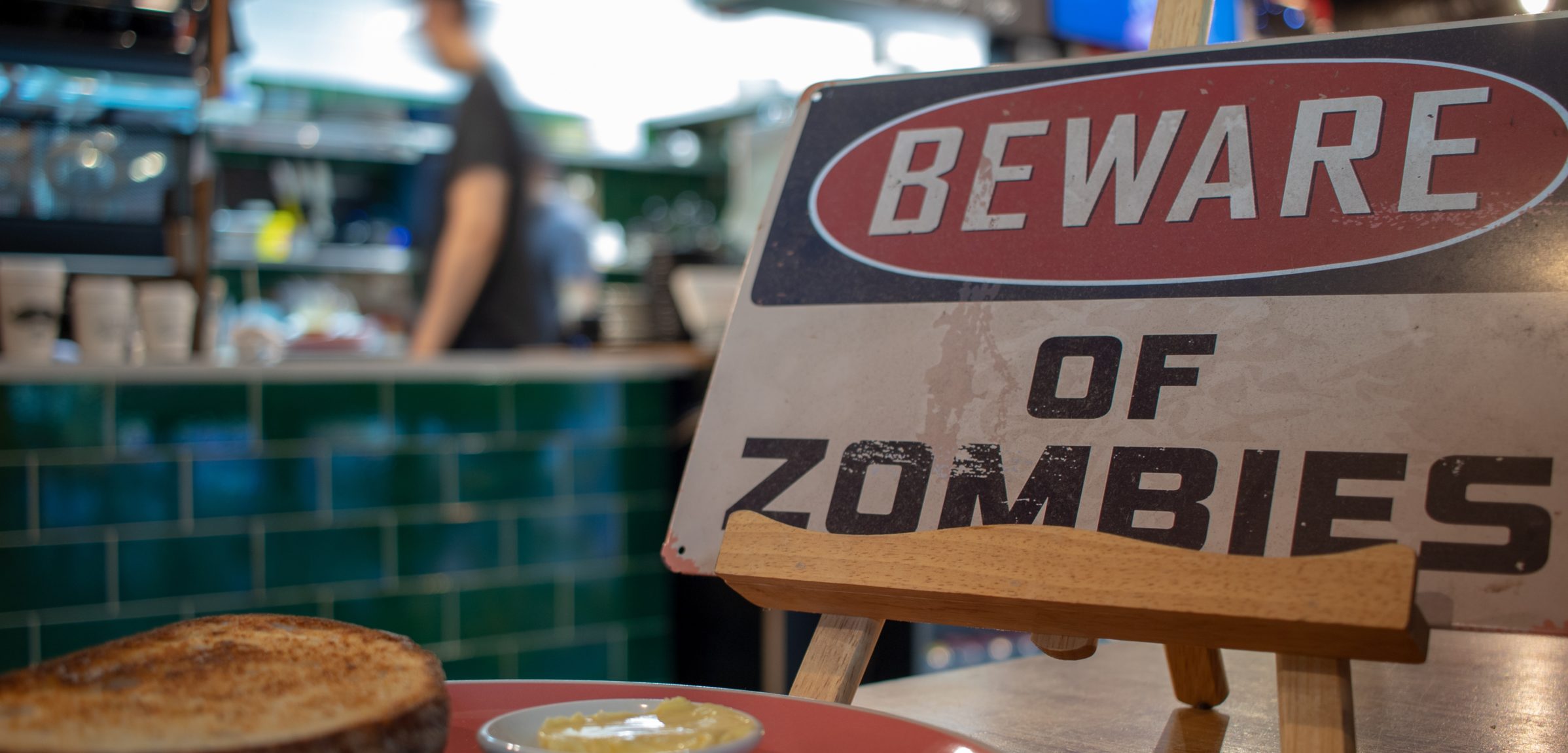
Zombies are everywhere. Ever since the classic “Night of the Living Dead,” the undead have shown up in movies. Zombies now are featured in top-rated cable TV shows, and in apocalyptic novels and survival guides. An entire genre has ignited around the concept of adding zombies to classic literature (”Pride and Prejudice with Zombies,” etc.). But why are we drawn to these gruesome figures?
In the New York Times, columnist Amy Wilentz reminds us why zombies scare us, and why we can’t help but watch through our clenched hands covering our eyes. The zombie myth is rooted in something quite real, and quite terrifying. The zombie stories emerged in a Caribbean context of brutal slavery. The zombie’s horror is that he is, she writes, a slave forever. After all, if even death cannot free you, you can never be free.
That’s exactly the point, and here’s why it should matter to Christians.
Zombies are horrifying not simply because they’re mean and aggressive. They are horrifying because they represent what ought to repulse us: the rotting decay of death. But they still walk. And, beyond that, they still crave. In their search for human brains, they are driven along by their appetites, though always under the sway of a slavemaster’s will.
That’s our story.
The biblical story of the Fall of humanity is one of a humanity that comes under the sway of death by obeying the appetite. God places a fiery sword around the Garden of Eden, Genesis tells us, so that the primeval humans wouldn’t eat of the Tree of Life and live forever. Why? It’s because God didn’t want to consign humanity to a never-ending existence of this kind of walking death. He sentences us to the curse of death so that, ultimately, we can be redeemed.
The gospel tells us that, apart from Christ, we were walking in the flesh, that is slavishly obeying our biological impulses and appetites without the direction of the Spirit. As such, we were “dead in trespasses and sins” (Eph. 2:1). But we weren’t inert. We instead, though dead, “walked, following the course of this world, following the prince of the power of the air” (Eph. 2:2). We were walking dead slaves.
And, in our death, our appetites weren’t silenced but instead drove us along. This walking death, the Apostle Paul writes, was driven along as we “carried out the desires of the body and the mind” (Eph. 2:3).
Caribbean people could resonate with the horror of zombies because they knew what it was like to be enslaved by evil people, with no hope of escape. And maybe our culture pays attention to zombies because we know what it is like to be dead inside, but unable to find peace, unable to stop walking.
The gospel doesn’t just extend our lives forever into eternity. That’s what we, left to ourselves, think we want. The rich young ruler asks Jesus how he can inherit eternal life, but Jesus points out that he wants to eternalize his present state rather than to be hidden in the life of Jesus himself. That’s a zombie walk, and Jesus loves us too much for that.
Jesus offers instead life, and that abundantly, as we eat of his flesh, drink of his blood, share in his triumph over the accusing slavemaster.
So let’s have some sympathy for the zombies. And next time you see the trailer for a zombie film, or see the picture of a walking corpse on the cover of a novel, remember that that was your story once too.

36 Responses to “Why Zombies Matter”
Trackbacks
- SBTS Southern Blogs » Why Zombies Matter
- A great article by Russell Moore: Why Zombies Matter « Kingdom Echoes
- This Week’s Good Reads | Pastor Dave Online
- Why Zombies Matter « A Modern Puritan
- Flotsam and jetsam (11/2) | Everyday Theology
- Mere Links 11.02.12 - Mere Comments
- The Walking Dead, Indeed | The Chi Files
- This and That – 11-03-12 « The Thompsonian Times
- Why Zombies Matter
- Why Zombies Mattet |
- Thursday Re-blog « My Studies
- Why Zombies Matter « The Vineyard Ministry


Excellent theological and biblical connection to a current trend in our culture. We are all in need of redemption from the curse of death.
I am a zombie redeemed! Thank you for this insightful articl Dr Moore.
What an apt analogy, Dr. Moore! Thank you for this picture of our lives as they are in their ‘natural’ state. How different things are when one is In Christ! We no longer walk as the zombies also walk, but we lay aside that corrupted flesh and put on the new self of holiness in Him.
There are spiritual connections to be made with the zombie phenomenon, culture, and spirituality - but you fail to make them for one critical reason: you do not understand the zombie genre.
You mention the history, the books, the TV, the movies, but clearly you have failed to actually read and watch them. Zombies as slaves of a Voodoo master? Not since “White Zombie” (in the days of black and white movies). Zombies eating brains? That is a trope held only in spoofs of the zombie genre.
If you wish to engage people who enjoy the zombie genre, and use it as a tool to draw them towards Christ, then first take the time and do your homework.
@Oakspar, I fail to understand why it’s critically important to have a comprehensive knowledge of the zombie genre to make an analogy…one that isn’t contigent upon trivial details in order to be poinent and relatable. A general understanding certainly suffices to delineate this analogy, and actually connects with the reader quite well. He never mentions a “voodoo master” as you claim, and whether zombies consume brains or flesh, does it really matter at all? Nope. I for one, appreciate the zombie genre and this article was very helpful in drawing me toward Christ; no “homework” required. If I was the author of whose work you gave critique, it would not be well received, merely due to its utterly condescending tone.
@Oakspar, not to be disrespectful but I too do not understand your point. It doesn’t matter if the author has a great understanding of the zombie genre, he is only making a simple and good comparison between zombies and people walking in their sins.
@Oakspar, The zombie’s of todays culture are an accurate depiction of the demons of hell who want your soul in hell. It doesn’t matter what they do, how they do it or how glamorous hollywood makes them. Zombies (and I’ll add Vampiers) are a clear depiction of the battle for our souls by the devil. To glorify these creatures is to glorify the devil and his army of demons. I for one will have no part of it. I will all burn up in the end but because I keep my eye on the prize, I will live forever. Not as some tormented pathetic creature like a zombie or Vampire, but as a new creacture with a new body glorious and beautiful living forever with my Lord and Savior.
I preached this very thing, with this very zombie theme, this month as part of a horror-themed series I did for Halloween month! Zombies are truly a picture of our desperate need for a Savior! Thanks for this great post!
Thank You for making sense of such nonsense. I rather like being a zombie redeemed!
But does Dr Moore watch the Walking Dead?
consider Revelation 9: 6
Men shall seek death but it shall flee from them they will long to die but death will flee away
zombies? sounds like it to me
Dr. Moore,
Great post. Did you know that Marc Cortez (theology prof at Western) is writing a book about the gospel from this angle?
http://marccortez.com/2012/04/26/zombies-need-the-gospel-too-2/
I forgot to mention that the essay can be found on my blog: http://iyxy.wordpress.com/
Best
Great article. Related, I found the following 99 cent Zombies-in-the-Bible satire to be funny: (you may have to cut-and-paste to your browser, sorry)
http://www.amazon.com/dp/B0092Y8AYI
I finally understand this silly zombie craze. Thank you. But what’s with the “zombie-hunters”? Are they evangelists or depravity-deniers?
Slam dunk!
I think the stories/images/figures our culture can’t get away from (like zombies and vampires and monsters) are extremely significant theologically and promising for evangelism.
This is a classic example of contextualization. Comparing something that doesn’t matter (mythical creatures), to something that does (doctrine of depravity) reduces what does matter to what’s trite and fictional.
Why is America obsessed with Zombies? Google it and this is what you will find:
“I was interviewing a Zynga executive, Travis Boatman, SVP of Mobile, who has been making games for two decades, at our Ignition West conference today, so I asked him.”
“And Travis had a surprisingly precise answer.”
“People want to smash and maim and kill people, Travis says. But people don’t alway like smashing and maiming and killing real people because, well, there’s something unsettling about that.”
“Zombies are people, Travis continues, so they fulfill people’s desire to smash and maim and kill people. But they’re also already dead. So there’s nothing unsettling about smashing and maiming and killing them.”
Nevertheless a fitting and wholesome blog entry for such a momentous date.
@Seth Bishop, I have to agree, this was just a silly article. What’s next, vampires and the blood of Jesus? I mean why bother?
@Luke Ariel.,
The funny thing is that most of the people who watch the gore-crazed pictures such as The Walking Dead (at least the ones in our college dept at church) are playing video games of the same genre.
Don’t get me wrong; to stay up-to-date with the culture (I’m only 30), I tried watching an episode of The Walking Dead once with my wife, and within 2 mins there were pictures of near-vomit-inducing gore. We changed the channel (not because we are THAT holy, but because we didn’t want to clean up vomit). Such is the norm with the genre, at least in my limited experience (i guess we’ll chalk that one up to pure coincidence).
But if that’s what you like to point you (and to those you minister) to whatever picture of depravity you have of yourself, and you do such to “the glory of God” please do not let me be the one to say that your spiritual barometer is off.
Do Zombies Matter? Uh, Not So Much.
For purposes of sermon illustrations, these sorts of pop culture analogies can be effective and worthwhile. As well, the ability to create them can provide much-needed justification (or rationalization) for our spending time viewing such disposable secular entertainment as The Walking Dead (http://piouseye.ws/VHIECZ). These analogies often don’t hold up well under sustained analysis, however.
It should first be noted that Moore’s article goes astray early by committing the zombie-analysis equivalent of the etymological fallacy that plagues much popular Bible teaching. The apparent first use of zombie stories as a metaphor for slavery in the Caribbean context really has no relevance to the analysis of contemporary zombie movies and television, where the context and intent is entirely different. (As I have not read any zombie literature, I will exclude consideration of such from my remarks.) If Moore wonders why one commenter (Oakspar) seems a bit irked, this is likely the reason.
With reference to contemporary zombie films and television, Moore’s analysis seems at best strained, depending on the idea that viewers empathize or in some way identify with the zombies: “maybe out culture pays attention to zombies because we know what it is like to be dead inside, but unable to find peace, unable to stop walking.” The invariable dynamic of these productions, however, has viewers identifying solely with the non-zombie, very-much-alive and desperate-to-stay-so humans trying to survive the zombie menace. Whereas Scripture portrays humans as spiritually dead from conception until regenerated by sovereign grace, zombie films portray humans as alive and free until and unless zombified. That The Walking Dead has made even the living carriers of the zombifying infection does not seem to change this dynamic. Zombies in that series, as in any other contemporary zombie cinema I’ve viewed, are an insensate destructive force like plague or cancer, emphatically not people-like-you-and-me.
If I had to guess at the real reason that contemporary zombie productions appeal to people, I would say their appeal owes to the ubiquitous human fear of physical death. Zombies are the ever-present, always- spreading reality of inevitable physical death, something always threatening to kill even the youngest and healthiest among us should we get careless or find ourselves “in the wrong place at the wrong time.” Viewing them as pre-regenerate persons awaiting salvation seems intolerably strained, though by all means feel free to continue treating them as such if you find these walking dead liven up your sermons.
@David M. Hodges, you must not live in Louisville. People are obsessed with zombies and spend a fair amount of money to give the appearance that they are zombies. I don’t think Dr. Moore even said they ” empathize or in some way identify with the zombies” I believe what he is saying is that they should. The reason hat they should is because they are dead, and the reason they are obsessed with the zombie genre is because they are desperate to live and (as you said) afraid to die. I think that your point about the fear of physical death furthers Dr. Moore’s point that death is repulsive and should be repulsive but that death exists so that we might be redeemed.
In regards to your statement that Dr. Moore isn’t contextually accurate by bringing up the history of zombies, it should be noted that the only time he speaks of anyone resonating with an undead slave he says the following: ” Caribbean people could resonate with the horror of zombies because they knew what it was like to be enslaved by evil people, with no hope of escape.” I believe he stays true to the historical context without trying to push the issue into our present context.
Seth- That is certainly one interpretation of the zombie craze, but a very superficial one, and really only applicable primarily to video games, and perhaps some of the more exploitative genre films.
A brief examination of some of the more significant pieces in the movement suggests that there is a much more serious and contemplative undercurrent to the genre. Consider a few major themes: “In a world ruled by the dead, we are finally forced to start living.” -Robert Kirkman (back cover of The Walking Dead Compendium 1). Kirkman, moreover, has stated pretty clearly that his comic series has more to do with human interaction in a collapsed society than with the zombies qua zombies.
Society- how do humans function in the absence of clear authority figures, pitted in a struggle for survival?
Morals- how can people sustain their humanity in such situations? Survival at what cost?
Lifestyle- Kirkman offers the question of what life would be like in the absence of hours spent on tv, without the luxuries we take for granted, spending days avoiding danger and looking only to acquire the means to survive another night.
These and more are many considerations to be found within the zombie genre. It’s really not all about cathartic violence. That is only a small sliver of what is to be found in it, and really not representative of the genre as a whole.
Dear Russel
I am a student at Oak Hill College, London, and completed a cultural exegesis assignment on Zombies. You and your subscribers might be interested in my analysis. I’d love to know what you and your subscribers think.
It might be helpful in pushing your analysis a bit deeper.
I have also made a short zombie video to test my thesis. Its a bit of fun.
Blessings
James Crooke
Zombies you wrote? Biblical Apocalypse you entertain? Right on the money! google the biblical zombie apocalypse.}