





Our Top 10 Posts of 2012

— Monday, December 31st, 2012 —

2012 has yielded to 2013 at last. Looking back, here are the top ten most-read blog posts here at Moore to the Point. Thank you for reading and for dialoguing with me about all sorts of things. I look forward to our conversation in 2013. As Fred Rogers, would say, “You’ll have things you’ll want to talk about … I will too.”

1. Christians, Let’s Honor the President

The American people have decided that Barack Obama should have a second term. And, behind them, in the mystery of providence, God has decided that Barack Obama would be re-elected. So how should Christians respond to our once and future President?

2. School Shootings and Spiritual Warfare

Violence against children is not just tragic—it’s satanic. Throughout history the evil one has lashed out against children because they remind the satanic powers that a Child uproots their reign. The Incarnation, we must remember, was an act of war—the entry of the prince of peace who will crush the skull of the ancient murderer of Eden. We grieve in the midst of these tragic deaths, then, and we also pray for the returning of Mary’s Son who will crush the head of the serpent.

Keep Reading…

What Christians Can Learn from the Failed Mayan Apocalypse

— Friday, December 21st, 2012 —

It’s the end of the world as we know it and I have a mild cold. But, otherwise, I feel fine.

The jokes are pinging around social media and the television networks about the so-called Mayan apocalypse, based on a reading of a Mayan calendar ending on December 21 of this year. Of course, no one but the most obviously gullible people actually worried about this. And these were the same people who still had stored-up water and canned goods for the Y2K apocalypse from 1999.

I think there’s something we ought to pay attention to here that can help us read why Christianity seemed so incredible in the first-century, and why it still seems so incredible now. Our forefathers, the apostles of our Lord Jesus, looked to the world like the Mayan apocalypse hawkers.

Keep Reading…

Let’s Rethink Our Holly-Jolly Christmas Songs

— Tuesday, December 18th, 2012 —

Sometimes I learn a lot from conversations I was never intended to hear. This happened the other day as I was stopping by my local community bookstore. It’s a small store, and a quiet store so it was impossible not to eavesdrop as I heard a young man tell his friend how much he hated Christmas. And, you know what, the more he talked, the more I understood his point.

This man wasn’t talking about the hustle and bustle of the holidays, or about the stresses of family meals or all the things people tend to complain about. What he hated was the music.

This guy started by lampooning Sting’s Christmas album, and I found myself smiling as I browsed because he is so right; it’s awful. But then he went on to say that he hated Christmas music across the board. That’s when I started to feel as though I might be in the presence of the Grinch. You know, when every Who down in Who-ville, the tall and the small, would stand close together, with Christmas bells ringing; they’d stand hand-in-hand. And the Who’s would start singing. The sour old green villain didn’t like that.

But then this man explained why he found the music so bad. It wasn’t just that it was cloying. It’s that it was boring.

Keep Reading…

Russia’s Orphans at Risk Again

— Monday, December 17th, 2012 —

As I write this, I am waiting for my wife and children to return from a few days away visiting some of her relatives. In that van headed for Louisville are our first two sons, whom we met for the first time a decade ago in a Russian orphanage. Other babies, like they were, are in jeopardy again.

ABC News is reporting that the ruling United Russia Party is threatening to ban all U.S. adoptions in retaliation for President Obama signing into law sanctions for Russia’s abysmal record on human rights. In order to defend their horrifying lack of respect for human dignity, some Russian bureaucrats are willing to sacrifice the lives of their own children, languishing by the thousands in orphanages as we speak.

This would be no issue, of course, if the orphanages of Russia were empty. That’s what we should pray and hope for, everywhere.

Keep Reading…

School Shootings and Spiritual Warfare

— Friday, December 14th, 2012 —

The nation is watching, with horror and disgust, news reports out of Connecticut of a horrific act of violence against an elementary school filled with defenseless children. While every act of murder ought to provoke outrage, there’s something especially condemnable about the murder of children. I think there’s a reason for that.

In the hours after the shooting, Jewish political and cultural commentator John Podhoretz called attention to a concept most Americans don’t like to think about at Christmastime, if ever: hell. Podhoretz noted the heightened iniquity of child sacrifice in the Hebrew Scriptures’ denunciation of the god Moloch. Moloch, of course, was a blood-thirsty deity who demanded his followers to pour out the lives of their children. The valley of this atrocity was called Gehenna. Jesus pointed to Gehenna when he told us about hell.

Throughout the history of the universe, evil has manifested a dark form of violence specifically toward children. Not only did the Canaanite nations demand the blood of babies, but the Bible shows where at points of redemptive crisis, the powers of evil have lashed out at children. Pharaoh saw God’s blessing of Israelite children as a curse and demanded they be snuffed out by the power of his armed thugs. And, of course, the Christmas narrative we read together this time of year is overshadowed by an act of horrific mass murder of children. King Herod, seeing his throne threatened, demands the slaughter of innocent children.

Keep Reading…

“It Wasn’t His Child” by Trisha Yearwood

— Friday, December 14th, 2012 —
The Cross and the Jukebox

It’s beginning to look a lot like Christmas, and we all know what that means. There are lots of reindeer, elves, and lit-up wise men in communities all over America. But we don’t hear a lot about Jesus’ father. No, I don’t mean Jesus’ biological Father, the God of Israel. I mean Jesus’ adopting father Joseph of Nazareth.

When you listen to Christmas music, there are lots of songs about our Lord’s mother, the Blessed Virgin Mary: not just “Ave Maria” but CCM/pop stuff along the lines of “Mary, Did You Know” and so on. But Christmas music, like Christian churches, tends to ignore Joseph.

Keep Reading…

Joseph of Nazareth Meets Planned Parenthood

— Thursday, December 13th, 2012 —

A few years ago the Planned Parenthood Federation of America got my attention by pioneering a Christmas card. The group sent a holiday greeting — complete with sentimental snowflakes and stars — with the caption “Choice on Earth.”

Evangelicals and Roman Catholics rightly noted the incongruity of the nation’s largest abortion provider using an ancient Christian holiday to promote abortion rights. The give-and-take over this card was a quick controversy, forgotten once all the wrapping paper and tinsel were put away for the season.

But the card made me think of Joseph, and how this obscure Middle Eastern laborer could show 21st-century Christians how to celebrate Christmas in a culture of death?

For too long, Christians have concentrated almost exclusively on what we do not believe about Joseph.

We rightly insist that he was not the birth-father of Jesus. Mary, a virgin, conceived the Messiah through the power of the Holy Spirit, with no biological contribution from a man (Luke 1:34-35). And yet, there is so much more that Scripture has to say about Joseph.

In his adoption of Jesus, Joseph is rightly identified as Jesus’ father (Luke 2:41,48). Indeed, Matthew and Luke trace Jesus’ roots in Abraham and David through the line of Joseph. It is through Joseph that Jesus is a legal heir to the covenant promises of the Old Testament. It is through Joseph’s legal fatherhood of Jesus that the “hopes and fears of all the years” find their realization in the final son of Abraham, son of David and son of Israel. Jesus did not share Joseph’s DNA, but he claimed him as his father, obeying Joseph perfectly and even following in his vocation. Joseph, after all, was perhaps the first to hear the word “Abba” in the babbling of the Nazarene infant.

With full legal rights to abandon Mary and her unborn child — perhaps to a fate worse than death — Joseph obeyed the Father in becoming a father. When Herod — the Roman Empire’s precursor to “Planned Parenthood” — sought the destruction of the infants, Joseph shielded this child from the murderous rage of infanticide (Matthew 2:13-18). In his obedience, Joseph demonstrated what his other son would later call “pure and undefiled” religion, the kind that cares for the fatherless and the abandoned (James 1:27).

It is here that Joseph is perhaps a model for a new generation of Christians. In a culture captivated by the spirit of Herod, could it be that God is calling our churches to follow the example of Joseph? This might mean a battalion of new church-sponsored crisis pregnancy centers, able and equipped to provide an alternative for confused young women who might otherwise listen to the slick but deadly propaganda of the Planned Parenthood profiteers. It may mean pastors prophetically calling on Christians to oppose the abortion culture by actually rescuing babies through adoption.

It will mean Christian parents willing to open their hearts and their homes to unwanted infants — infants that Planned Parenthood would like to see carried out with the medical waste. It might mean that, next year, there will be one more stocking at the chimney at your house — a new son or daughter who escapes the abortionist’s knife to find at your knee the grace of a carpenter’s Son.

Planned Parenthood thinks “Choice on Earth” is the message of Christmas. Maybe it is in a Christmas culture more identified with the shopping malls than with the churches. But maybe this year Christians should follow the footsteps of the “other” man at the manger.

And maybe this year, as we gather to read the angel’s proclamation to the shepherds, we can remind a miserable generation that there is something more joyous than “choice.”

This post has been adapted from a piece that originally appeared at Baptist Press on December 12, 2012, under the title, “Joseph of Nazareth Meets Planned Parenthood.”

Should a Christian Photographer Work at a Same-Sex Wedding Ceremony?

— Tuesday, December 11th, 2012 —
Questions and Ethics

Dear Dr. Moore,

I am an evangelical Christian, and I work as a wedding photographer. By conscience, I hold to an orthodox view of human sexuality, with all that entails. I’ve been asked to photograph a same-sex wedding service (legal in my state), and I’ve said no. I wonder if I did the right thing.

After all, this is a business, providing a service. Would it be right for me to refuse to serve a gay couple if I owned a restaurant? I don’t think so.  If a same-sex marriage isn’t a marriage at all (as the historic Christian view teaches), then how is this different from just photographing people at a birthday party or community festival (in which case it wouldn’t matter what’s happening with them sexually).

Moreover, I’m not sure that photographing an event is an endorsement of that event. I have photographed weddings of people who were divorced (and I didn’t investigate the background), people who were probably cohabiting, people who were most likely unequally yoked to one another, and so on.

So I’m kind of caught. My conscience bothers me because I turned this couple down, and my conscience will bother me if I photograph this wedding. What do you think?

The Wedding Photographer

Keep Reading…

Book Recommendation: My Ideal Bookshelf

— Saturday, December 8th, 2012 —

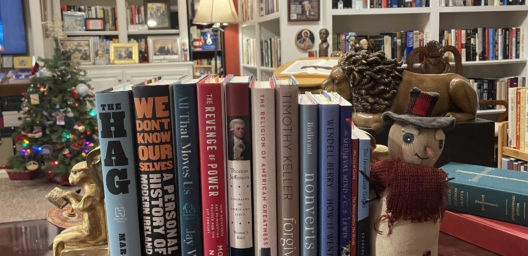
One of the things I miss most about bookstores, as they close down one by one all over the country, is the experience of coming across a surprise volume that Amazon would never know I’d want. Thankfully, there are still some good independent bookstores fighting it out across the land, and one of the best is Carmichael’s here in Louisville, KY. I am in there at least two or three times a week (sometimes more), and there’s almost always something new that gains my attention. That happened yesterday with a book that’s proven to be a lot of fun.

The book is called My Ideal Bookshelf. The volume asks notable people in a variety of fields, from Malcolm Gladwell to Judd Apatow to Rosanne Cash, to imagine a bookshelf with the books that made a mark on their lives. With each page-long essay, there’s a drawing by artist Jane Mount of the bookshelf.

Keep Reading…

Is the Culture at War with Christmas?

— Thursday, December 6th, 2012 —

Flipping through magazines on an airplane the other day, I found myself sighing with irritation. An advertisement for Budweiser was tagged with the headline, “Silent Nights are Overrated.” A few minutes later, in a second magazine, I came across an ad for a high-end outdoor grill, which read: “Who says it’s better to give than to receive?”

My first reaction was one that I’ve critiqued in others, to take some sort of personal, or at least tribal, offense: “Would they advertise in Turkey during Ramadan with the line, ‘Fasting is Overrated?’ or by asking in India, ‘Who says everything is one with the universe?’”

I was missing the point—and that matters.

Every year about this time, there’s a lot of hubbub about a so-called “war on Christmas.” In some instances, there are legitimate questions of religious liberty involved and complicated church/state questions that we ought to be concerned about. More commonly, though, the outrage is directed toward the commercial marketplace, for replacing “Merry Christmas” with “Happy Holidays” and so on.

As Christians, we ought to recognize that a militant pull toward what Richard John Neuhaus called a “naked public square” is bad for people of any and all religious traditions. But there’s a difference between, for instance, standing against a school system penalizing a child for writing “Merry Christmas” on her “holiday card” and the kind of huffing and puffing we do when commercial marketers don’t “get” our Christian commitments.

I should have thought about the fact that the advertising agencies behind this beer company and this grill corporation are trying to sell products, not to offend constituencies. Taking shots at any group’s religious beliefs isn’t good economics, and that’s just the point. I’m willing to bet whoever dreamed up these ad campaigns didn’t “get” at all that they might be making fun of Jesus Christ.

Madison Avenue probably didn’t trace through that the song “Silent Night” is about the holy awe of the dawning Incarnation in Bethlehem. It’s just a Christmas song, part of the background music in our culture this time of year. Saying it’s overrated probably didn’t feel any more “insensitive” to these copywriters than making a joke about, say, decking the halls or reindeer games or Heat Miser and Cold Miser.

And they probably never thought about the fact that the statement “It is better to give than to receive” is a quotation from Jesus (Acts 20:35). It probably just seems like a Benjamin Franklin-style aphorism. It’s the same kind of thing that happens when someone says “scarlet letter” without recognizing Hawthorne or “to be or not to be” while not knowing the difference between Hamlet and Shrek.

We ought not to get outraged by all that, as though we were some protected class of victims. We ought to instead see the ways that our culture is less and less connected with the roots of basic knowledge about Christianity. Many, especially in the culture-making wing of American life, see Christmas in the same way they see Hanukkah. They know about Menorahs and dreidels, but not about the Maccabean fight.

That ought not make us angry. It ought to instead give us an opportunity to understand how we look to our neighbors. They see us more in terms of our trivialities than in terms of the depths of meaning of Incarnation and blood atonement and the kingdom of Christ. They know something about “Silent Night,” just as they know something about “Grandma Got Run Over by a Reindeer.” What they don’t recognize is the cosmos-shifting mystery of Immanuel as God with Us.

All that means is that we need to spend more time lovingly engaging our neighbors with the sort of news that shocks angels and redirects stargazers and knocks sheep-herders to the ground. That it seems increasingly strange is all the better—because it is strange. A gospel safe enough to sell beer and barbecue grills is a gospel too safe to make blessings flow, far as the curse is found.

Christmas, then, isn’t about a fight for our right to party. It’s a reminder that we, like every generation before us, live in a “land of deep darkness” (Isa. 9:2). The darkness isn’t overcome by sarcasm or personal offense or retaliatory insults. The light of Bethlehem shines in the darkness, and the darkness has not, cannot, will not overcome it.

And that’s enough.

(Image Credit)